Aircraft design · conceptual and preliminary
Build todaythe aircraft of tomorrow.
DesignYourAircraft is a free web tool for designing fixed-wing aircraft: from the mission requirements to take-off mass, constraint diagram, geometry, stability, performance and costs, with the classic methods of the aircraft design textbooks. Everything is computed live, in your browser.
Start from an example aircraft ↓- Free
- No sign-up
- Runs in your browser
- 5 languages
L/D max
—
V max
—
Static margin
—
Mass
—
◆ Live numbers of your current project
How it works
From the idea to the aircraft, step by step
01 Mission
02 Sizing
03 Geometry
04 Flight
It all starts with the mission
Payload, range, cruise speed, runways: you describe what the aircraft has to do, event by event, and the fuel comes from flying that mission.
Try it here
Change the aircraft, watch the numbers move
Pick an example and drag the sliders: the drawing and the requirement check are recomputed live with the same methods as the tool. A bigger wing lowers the stall speed but costs speed; more power climbs better but burns more fuel.
Example – four-seat touring aircraft
…
Static margin: 11.8 %
See it in action
The real tool, not a mock-up
Screenshots of the tool with the example aircraft: what you see here is what you get.
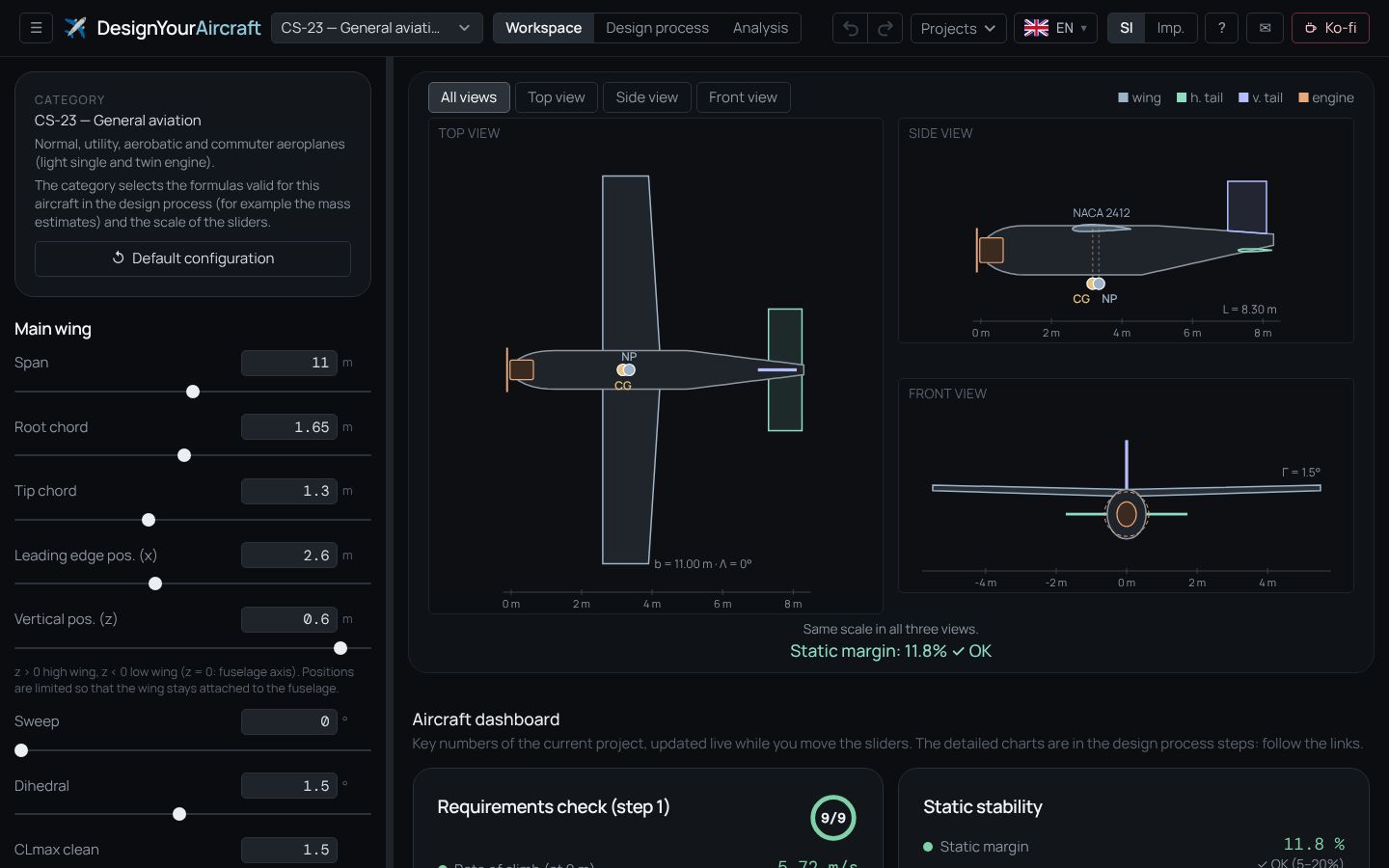
No black boxes: every formula has its source, every number has its unit, and every change shows up at once.
Features
A design office in a browser tab
For students, teachers, homebuilders and anyone who wants to understand how an aircraft is designed.
Guided process
Fifteen steps from the requirements to the finished aircraft, with a map that shows where you are and the design loops.
Live results
Sliders and fields update the drawing and every number instantly; the values that change light up for a moment.
Methods with sources
Classic methods from the aircraft design literature, listed in the credits. Estimates for preliminary design and teaching; the formulas are checked one section at a time.
Six categories
Sailplanes, general aviation, large aeroplanes, very light aircraft, military and UAVs: formulas and slider scales follow the category.
Analysis and costs
Performance summary, development, production and operating costs, break-even and a range map with real airports.
Your data stay with you
No account: projects are saved in your browser and can be exported as files. SI or imperial units, five languages.
Try it now
Start from an example aircraft
One click opens a complete aircraft of the category, with its mission and every requirement met. Change anything: it becomes your project.
Four-seat touring aircraft
Single piston engine, 900 km at 230 km/h, 500 m runways.
- Take-off mass
- —
- Span
- —
- Cruise
- —
- Range
- —
Single-aisle airliner
Twin jet, 150 seats, 3000 km at 780 km/h.
- Take-off mass
- —
- Span
- —
- Cruise
- —
- Range
- —
Touring motor glider
Two seats, long slender wing, small piston engine.
- Take-off mass
- —
- Span
- —
- Cruise
- —
- Range
- —
Light two-seater
Simple and light: 600 km, 400 m grass strips.
- Take-off mass
- —
- Span
- —
- Cruise
- —
- Range
- —
Jet trainer
Single jet engine, two seats in tandem, swept wing.
- Take-off mass
- —
- Span
- —
- Cruise
- —
- Range
- —
Small fixed-wing drone
About 20 kg, pusher propeller, 300 km.
- Take-off mass
- —
- Span
- —
- Cruise
- —
- Range
- —
Who it is for
For anyone who wants to see how an aircraft is designed
Students
Follow the same steps as an aircraft design course, with each method and its source in view: useful for projects and for exam preparation.
University teams
Design/build/fly, drone and aero-design competitions: size the aircraft quickly, compare options, share a project with one link.
Homebuilders and drone makers
Look at wing loading, centre of gravity, stability and performance before cutting the first part.
Teachers
Show live how a change of span or engine moves stall speed, range and stability. Free, nothing to install, in five languages.
Why trust the numbers
Classic methods, sources in plain sight
The methods come from the reference textbooks of aircraft design and every result states its assumptions. They are estimates for preliminary design and teaching.
Methods from
- Raymer — Aircraft Design: A Conceptual Approach
- Roskam — Airplane Design
- Gudmundsson — General Aviation Aircraft Design: Applied Methods and Procedures
- Sadraey — Aircraft Design: A Systems Engineering Approach
- Pamadi — Performance, Stability, Dynamics, and Control of Airplanes
- Torenbeek — Synthesis of Subsonic Airplane Design
Compared with real aircraft
Aircraft rebuilt from published data and compared with their published performance, with no tuning: the differences are shown, not hidden.
- Stall speed, flaps up
- Stall speed, landing flaps
- Max rate of climb at sea level
- Service ceiling
- Take-off distance to 15 m
- Landing distance from 15 m
- Range with maximum fuel
- Empty mass
In numbers
Everything you need, nothing to install
- design steps
- 15
- aircraft categories
- 6
- languages
- 5
- euros to use it
- 0
The process
Fifteen steps, one aircraft
Conceptual design, then preliminary design, up to the finished aircraft. Each step opens the tool right there.
Conceptual design
Questions
Frequently asked questions
Is it really free?
Yes. No paid plans and no sign-up. If it is useful to you, you can support it with a coffee on Ko-fi.
Do I need an account? Where are my projects saved?
No account. Projects stay in your browser; you can export them as a file or share them with a link. Your projects are not sent to any server.
How accurate are the results?
They are estimates for preliminary design and teaching, obtained with classical methods and simplified assumptions. The comparison page shows how far they are from real aircraft. They are not suitable for certification or flight-safety decisions.
Which aircraft can I design?
Fixed-wing aircraft: sailplanes and motor gliders, very light and general aviation aircraft, large transport aeroplanes, military trainers and small drones, with piston, turboprop or jet engines.
Can I use it for a course, a thesis or a competition?
Yes, as a support tool. Cite the textbooks the methods come from (listed in the credits) and check the results with your own calculations.
Do I need to know aircraft design already?
No: start from an example or from the guided tour. Each step explains what it does, and the textbooks are cited for those who want to go deeper.
Your aircraftstarts here.
Open the tool, choose the category and start from the mission. It takes a minute.
Estimates for preliminary design and teaching, obtained with classical relations and simplified assumptions: not suitable for certification, final structural design or flight-safety decisions.